Article
Auditing your AWS cloud in a single night: how AI is reinventing security and FinOps
Behind a “classic” AWS security audit lie weeks of manual work. What if an AI-powered platform could deliver, in a single night, a complete security and FinOps assessment—what a team produces over several days, with an unprecedented depth of analysis?
Three weeks for a report nobody reads
Everyone knows the scene. A management committee asks for “an assessment of our cloud security.” Three weeks later, a consultant delivers an 80-page PDF that no one will read to the end, already outdated by the time it arrives.
The problem isn’t the auditors’ talent. It’s the model. A serious AWS audit requires cross-referencing hundreds of configurations, dozens of accounts, thousands of resources—and then transforming that technical magma into actionable decisions. It’s slow, it’s expensive, and it’s inevitably incomplete.
So we asked a simple question: what if we automated everything, from data collection to executive summary, without ever sacrificing rigor?
Here are the core principles that make this possible—and why they’re a game changer.
Principle #1 — You keep the keys: read-only, revocable access
A CISO’s first objection is legitimate: “I’m not going to give a third-party tool access to my production environment.”
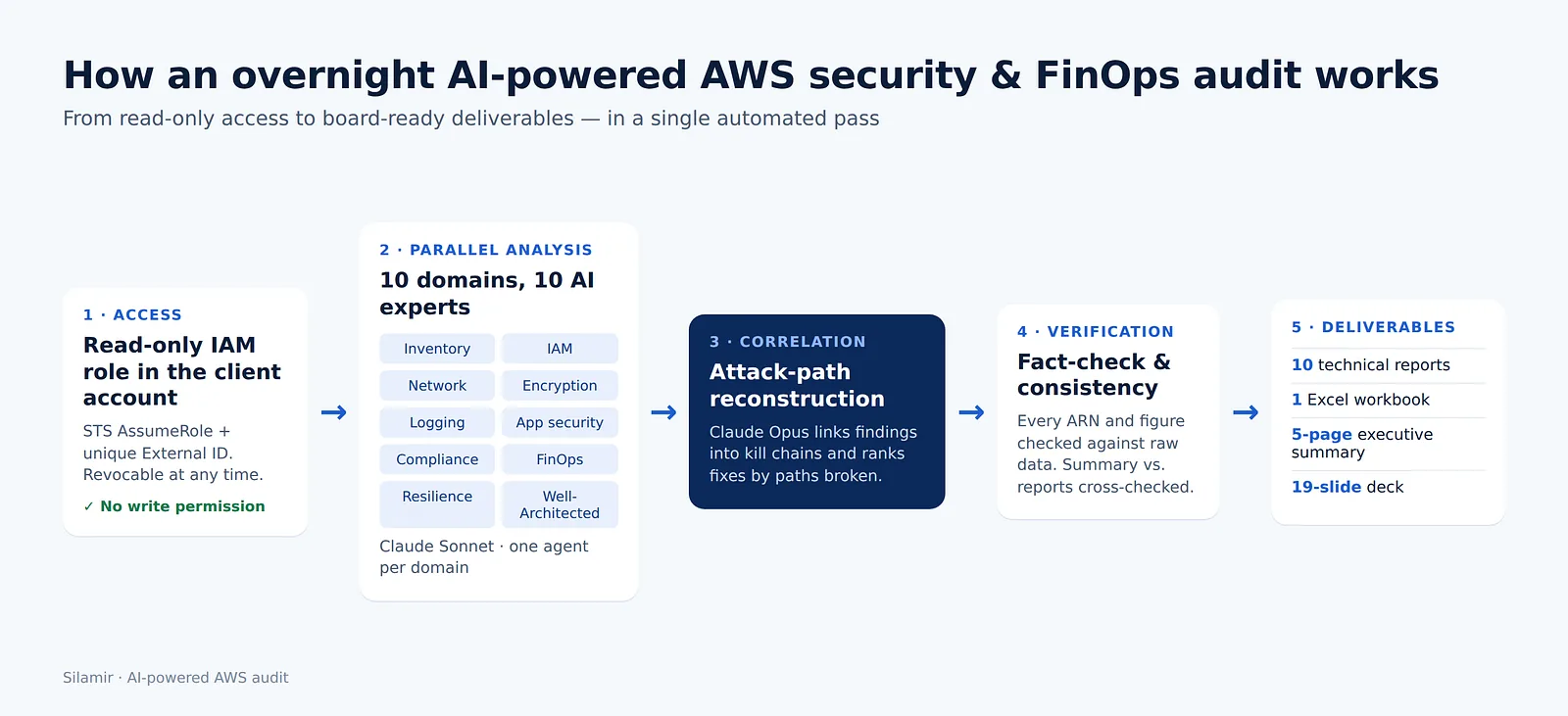
Good news: there’s no secret to share. The client deploys a read-only IAM role, which they fully control and can revoke at any moment. The platform connects to it via a standard AWS cross-account mechanism (STS AssumeRole), protected by a unique External ID specific to each client.
Concretely:
- Read-only, full stop. No modification command exists in the collection code. The tool observes; it touches nothing.
- No reckless copying of your data. Audit artifacts are encrypted at rest with dedicated keys and automatically deleted after 7 days.
- Every access is logged. The granular encryption model makes it possible to see, in the AWS logs, exactly which data was read and when.
Trust isn’t decreed, it’s architected. Here, the principle of least privilege isn’t a marketing promise: it’s a technical constraint built into the system.
Principle #2 — Ten AWS audit domains analyzed in parallel by AI agents
An AWS audit isn’t just “security.” It’s a dozen overlapping disciplines: inventory, IAM, networking, encryption, logging, application security, compliance, FinOps, resilience…
Rather than handling everything as one block, the platform launches ten simultaneous collections, each specialized in its own domain. The raw data is then analyzed by cutting-edge AI models (Claude Sonnet), one dedicated expert per domain, in parallel.
The result? What a human team processes sequentially over several days, the platform absorbs in a few minutes—without the fatigue, without the blind spots, without the “we’ll look at that later.”
AI doesn’t replace the expert. It removes the tasks that make them less effective: tedious collection, copy-pasting, reading 4,000 lines of JSON configuration at 10 p.m.
And for organizations that want it, an application penetration testing module (DAST) can scan exposed surfaces—automatically discovered, with no manual configuration.
Principle #3 — Attack path analysis: the real danger is never an isolated flaw
This is where it all comes together, and what distinguishes an intelligent audit from a simple checklist.
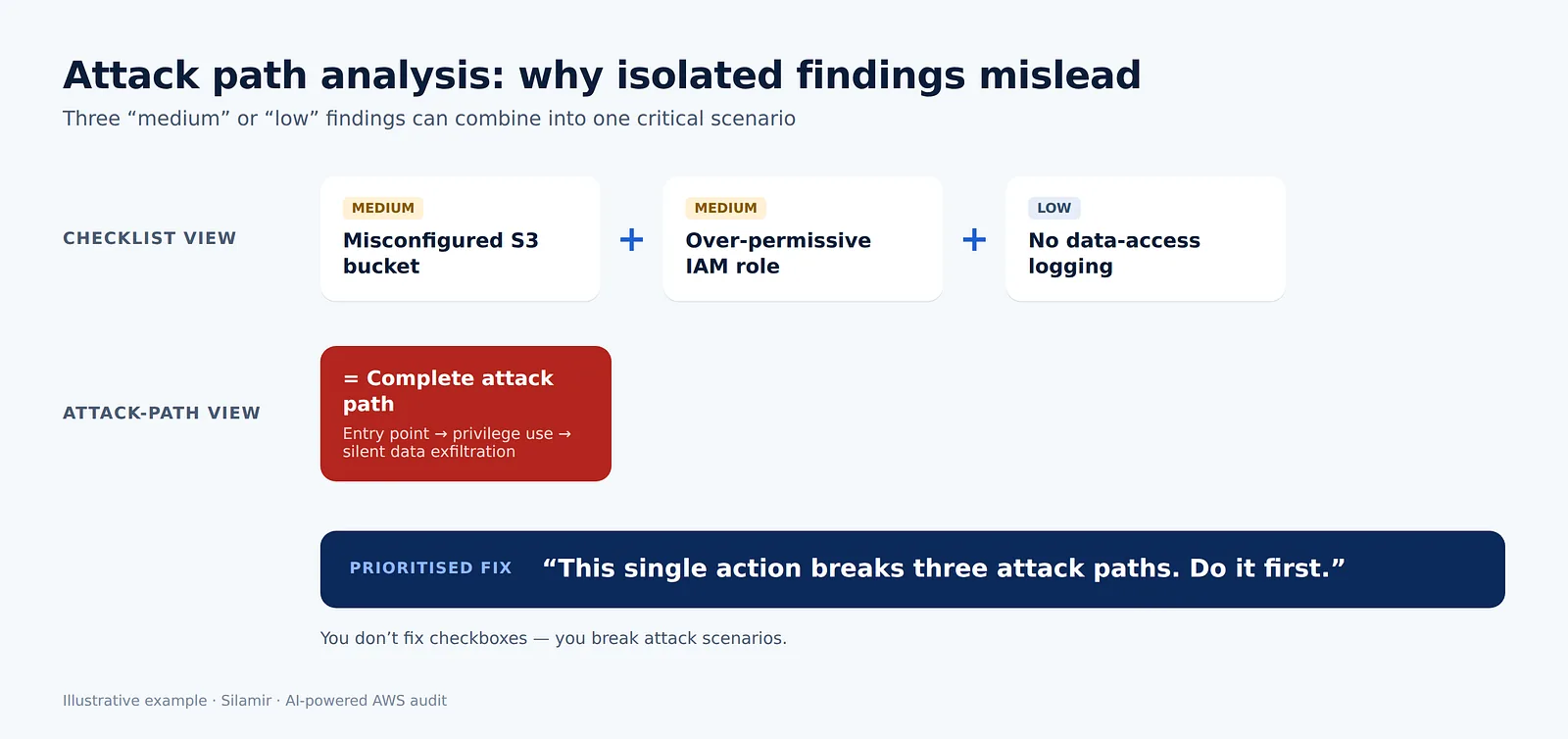
A single flaw is rarely catastrophic. What brings down an infrastructure is the chain reaction: a misconfigured bucket + an overly permissive role + an absence of logging = a complete attack path, from entry point to data exfiltration.
The platform deploys an advanced reasoning model (Claude Opus) to do work no checklist can do: reconstructing kill chains—those cross-cutting attack sequences that link vulnerabilities together.
The effect on prioritization is radical. Instead of drowning the client under 200 “findings” classified by abstract severity, it tells them:
- “This single action fixes three attack paths. Do it first.”
- “That red alert? On its own, it’s not exploitable. Later.”
You don’t fix checkboxes. You break attack scenarios. That’s the difference between a report you endure and an action plan you execute.
The FinOps dividend: cost optimization in the same pass
Security and cost are two sides of the same configuration. The idle instance nobody owns is also an unpatched attack surface; the forgotten snapshot is both a line on the bill and a copy of your data.
That’s why FinOps isn’t a separate engagement here—it’s one of the ten domains, analyzed from the same read-only access, in the same night. The FinOps agent reviews twelve months of spend by service, account and region, then looks for what a monthly bill never shows:
- Orphaned and idle resources — unattached EBS volumes, unused Elastic IPs, obsolete snapshots, load balancers with no traffic.
- Rightsizing opportunities — instances and databases sized for a peak that never comes.
- Commitment coverage — how much of your steady usage is actually covered by Savings Plans or Reserved Instances, and how well existing commitments are used.
Every recommendation is costed and tied to concrete resources, so the executive summary can put security risk and savings on the same page. For a CFO, that changes the conversation: the audit doesn’t just list what to fix—it helps fund the fixes.
Principle #4 — One deliverable for each audience
An audit only has value if it’s read and understood—by audiences that don’t speak the same language.
That’s why the platform produces, automatically and in a single pass:
- 10 detailed technical reports (Word + PDF), one per domain, with concrete resources, ARNs, and costed action plans.
- An Excel workbook for teams that want to sort, filter, and track.
- A 5-page narrative executive summary, designed for a CDO or CISO: no jargon, clear trade-offs, a trajectory.
- A 19-slide presentation deck, generated and visually reviewed by AI to guarantee layout quality worthy of an executive committee.
Each deliverable is calibrated for its reader. The engineer gets their technical depth; the executive gets their strategic vision. No one has to translate.
Principle #5 — Quality is verified, not assumed
This is probably the most counterintuitive point. “AI writing reports? What about hallucinations?”
A fair question—and that’s why the platform incorporates a double automatic verification before any delivery:
- Fact-checking against raw data. Every ARN cited, every figure put forward (“47 EC2 instances”) is checked against the data actually collected. An unsourced claim is flagged, never invented.
- Consistency check. A second model verifies that the executive summary doesn’t contradict the technical reports that feed it.
The system doesn’t just produce: it self-checks, then surfaces its own inconsistencies to the Silamir teams before sending to the client. Trust in an AI deliverable doesn’t come from faith—it comes from traceability.
Beyond the audit: an infrastructure exemplary by design
There’s a reassuring coherence in entrusting your security audit to a platform that applies to itself the standards it evaluates. The platform continuously adheres to leading frameworks—CIS AWS Foundations, AWS Foundational Security Best Practices—with:
- at-rest encryption using dedicated, compartmentalized keys (a compromise on one perimeter doesn’t expose the others),
- automated detection of unintended external access,
- weekly monitoring of configuration drift,
- strict network isolation and immutable containers.
For once, the cobbler is the best-shod of all.
What it really changes
Reducing an audit from several weeks to a single night isn’t just about saving time. It’s about making the audit repeatable.
An annual audit gives you a snapshot. An audit you can re-run at will gives you a film—the ability to measure your progress, validate a remediation, and verify the real state of your cloud before a board meeting, a fundraising round, or a certification.
Cloud security isn’t a project. It’s a permanent state. The tools that support it should be too.
Want to see what an audit delivered in a single night looks like on your own environment? The role is read-only, revocable, and the first analysis speaks for itself. That’s often where the conversation truly begins.
Ready to audit your AWS account?
Subscribe on AWS Marketplace, deploy the read-only role and get your reports within the hour.